Pages

Showing posts with label Study Guides. Show all posts

May 8, 2013

4G History Study Guide (Ch. 17 Terms)


4th Grade History
STUDY GUIDE – CHAPTER 17
Terms to know
  1. Alliance – a promise between two or more countries to fight together against their enemy in time of war
  2. Allies – the United States was part of this power during World Was II, against Germany
  3. Axis Powers – the countries that sided with Germany
  4. Lusitania
    •  English passenger vessel sunk by German U-boats
    • this angered Americans, but America did not enter the war at this time
  1. Nationalism – a sense of loyalty to one’s own country
  2. Neutral nations – the countries that did not form an alliance during WWI
  3. Roaring 20’s – name for the 1920’s b/c all was going well during those years
  4. U-boats
    • used by the Germans during World War I to destroy England’s ships carrying food and supplies
    • called submarines today
  5. Veteran’s Day – celebrated as a day to honor all who have fought for our country in war
  6. V-E Day – when Germany surrendered to the Allies
  7. World War I – from 1914 to 1918                         
  8. Zimmerman Note
    • promised land in the United States to Mexico
    • a letter asking Mexico to enter the War on Germany’s side
  9. United Nations – an organization set up after World War II to help nations settle their problems

Places
  1. Great Britian – one of the only countries in Europe not occupied by Nazis
  2. United States – known as "the great arsenal of democracy"
  3. Hiroshima and Nagasaki – the bombing there caused the surrender of Japan
  4. Pearl Harbor – bombing there caused the United States to enter World War II
  5. Poland – when Hitler attacked there, World War II began
  6. Berlin – German city which was divided by the "Wall of Shame" after World War II

Country
Leader
Government
Axis / Allies
Russia
Stalin
Communism
Axis
Italy 
Mussolini
Fascism
Axis
Germany
Hitler
Nazism
Axis
Japan
Tojo
Militarism
Axis
U. S.
Roosevelt
Democracy
Allies

People
  1. Calvin Coolidge – first President to give the inaugural address over the radio
  2. Archduke Ferdinand – was shot by an angry youth which caused the start of World War I
  3. Hitler – Nazi leader who broke his alliance with the Soviet Union and attacked them
  4. Lenin – the cruel dictator who built the Communist empire called the Soviet Union
  5. Franklin D. Roosevelt – President of the United States during World War II
  6. Woodrow Wilson – President of the United States during World War I  he said, "The world must be made safe for democracy

April 29, 2013

4G History Study Guide (Ch. 15-16 Terms)


4th Grade Study Guide – Chapters 15 & 16
People
  1. Sir Henry Bessemer – developed a method of turning iron ore into steel
  2. Andrew Carnegie – made millions of dollars in the steel industry
  3. William Gorgas – helped rid Cuba and Panama of disease carrying mosquitoes
  4. Billy Sunday – baseball player who preached the gospel
  5. Charles Finney – a lawyer who became a great revival preacher
  6. Dwight L. Moody – a shoe salesman who became a famous evangelist and founder of the Moody Bible Institute
  7. Adoniram Judson – one of the first missionaries to India, known as the "Father of American Missions"
  8. Thomas Alva Edison – invented the phonograph
  9. Robert Fulton – invented the first successful steamboat
  10. Orville Wright – flew the first successful airplane (for twelve seconds)
  11. Garrett Morgan – a traffic signal with colored lights
  12. Jan Matzeliger – invented a shoe-lacing machine
  13. Samuel Morse – invented the telegraph                                                                                             
  14. Alexander Graham Bell – invented the telephone              
  15. Henry Ford – invented the Model T car 
  16. Robert Goddard – launched the first successful liquid fueled rocket

Places
  1. Canada – separates the United States from Alaska
  2. Panama Canal:
    • allows ships to cross from the Atlantic to the Pacific ocean without sailing around the tip of South America
    • France was the first country to attempt to build the Panama Canal
  3. Philippine Islands – where Admiral Dewey destroyed the Spanish fleet during the Spanish-American War
  4. United States – won the Spanish-American War
  5. Russian America – Alaska was once called this
  6. Gold – Alaska was considered worthless to most Americans until gold was discovered in 1896
  7. Territory
    • owned and controlled by the United States but has not reached the status of statehood
    • does not elect its own officials or vote for the President
 Map work – know the locations of states and capitals on a map

February 26, 2013

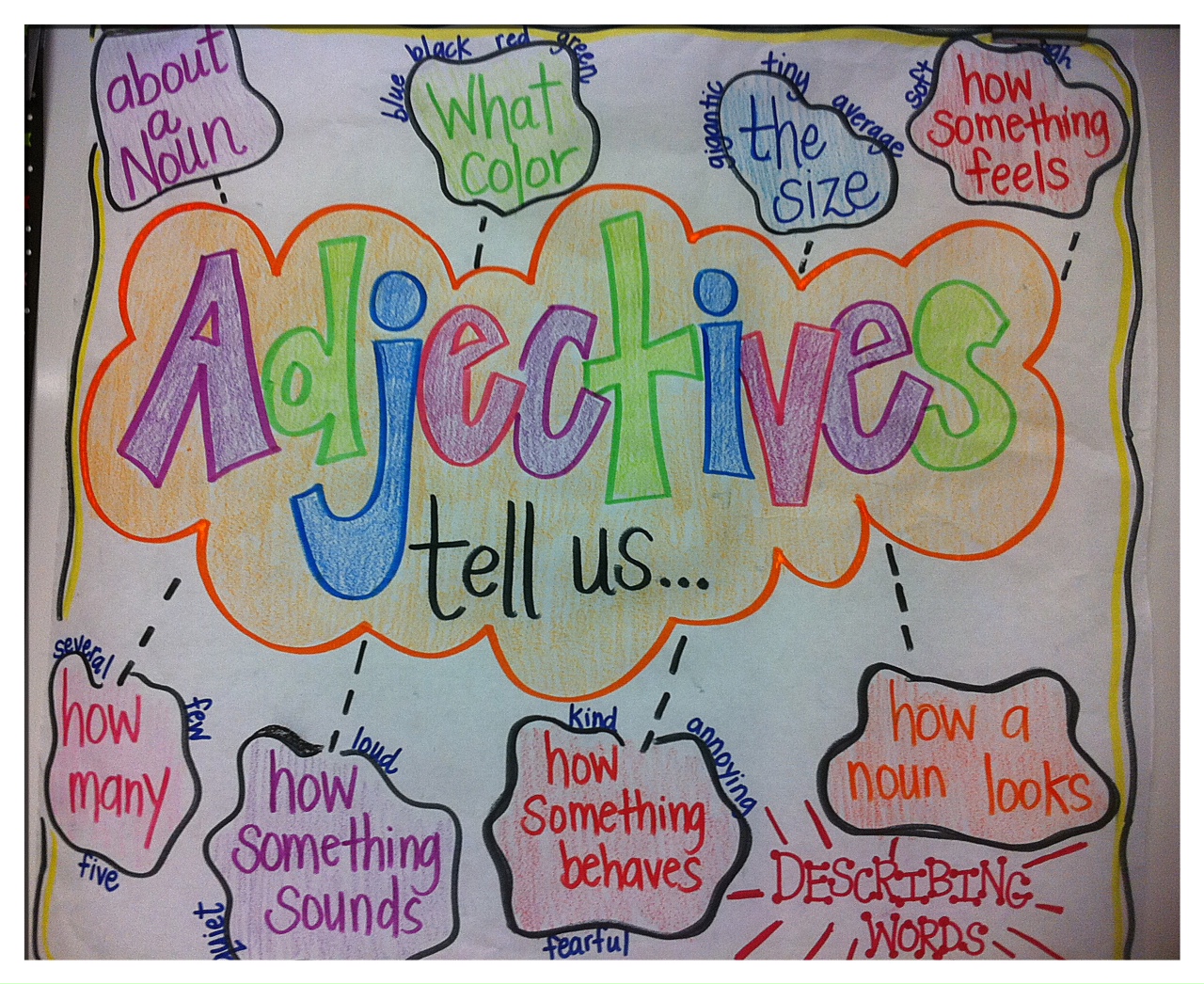
Adjectives Review 1


Adjective Study Guide
Source: http://mrswarnerarlington.weebly.com/
uploads/6/9/0/0/6900648/adjectives3.jpg

  • An adjective is a word that describes a noun or pronoun.  
    • Adjectives tell whose, how much, what kind or how many. 
      • Encyclopedias have accurate information.  (what kind)
      • A library has several dictionaries.  (how many)
  • Articles--a, an, the
    • Articles are special kinds of adjectives.  Use a and an to refer to any one item in a group.  
    • A is used before words beginning with a consonant sound.  
    • An is used before words beginning with a vowel sound.
    • Use the to refer to a particular item or items.
  • Demonstrative Adjectives--this, that, these, those
    • A demonstrative adjective comes before a noun.  
    • Demonstrative adjectives tell which one or which ones.  
    • This and these are used to point out nearby people or things.
    • That and those are used to point out people or things far away.
    • This and that (singular)
    • These and those (plural)
  • A proper adjective is formed from a proper noun.  
    • A proper noun names a certain person, place, thing, or idea.  
    • A proper adjective begins with a capital letter.  (Japanese, African, Hawaiian).
  • Comparative adjectives compare two nouns or pronouns.  
    • Add er to most adjectives or add the word more before longer adjectives.
  • Superlative adjectives compare three or more nouns. 
    • Add est to most adjectives or add the word most before longer adjectives.
  • Forms of good and bad:
    • good, better, best
    • bad, worse, worst
    • _________________________________________________________________-

      4th Grade Language 
      Study Guide – Adjectives/ Review 

      Noun – names a person, place, or thing
      Verb – shows action, or state of being
      Pronoun – takes the place of a noun
      Adjective – describes nouns or pronouns
      1. answers: Which one? What kind? How many? How much? Whose?
      2. a, an, and the are always adjectives – they are called articles

      Writing Comparisons – adding –er or -est
      1. if the adjective ends with a short vowel sound before the final consonant, then double the final consonant before adding –er or –est
      2. if the adjective ends in e, drop the final e before adding –er or -est
      3. whenever you use –er or –est, make sure you state what you are comparing

      Information below is NOT on the next test on 2/27.
      Adverb – describes verbs, adjectives, and adverbs
      1. answers: Where? When? How often? To what extent? How?
      2. often ends in –ly
      Preposition – shows relationship (learn the list of common prepositions)
      Example: The bird flew in her cage.
      Object of the preposition – the noun after the preposition
      Example: The bird flew in her cage.
      Conjunction
      1. joins words or groups of words
      2. common conjunctions include: and, but, or, nor, yet, for
      Interjection – shows strong or sudden feeling
      Example: Ouch! That bee stung me!
      My, look how well you did!

November 30, 2012

Ch. 5 Review Guide (4G.)


4th Grade Science
Study Guide – Chapter 5: Matter
212° F – temperature at which water boils

Gravity – the force that draws things toward the center of the earth
32° F – freezing and melting point of water / ice

Hail – frozen raindrops that have been blown back into the cloud to form more frozen layers

Air mass – a large body of air that has the same temperature and humidity

Humidity – the amount of water vapor in the air

Atmosphere – layer of air surrounding the earth, extending 1,000 miles, its weight
creates air pressure

Matter – anything that takes up space and has weight

Condensation – the process of changing water vapor into liquid water

Molecules – the smallest piece of a substance that still has the qualities of that substance

Dew point – the temperature water condenses

Nimbus – a storm or rain cloud
Energy – the ability to do work

Nitrogen – the gas that makes up most of the air
Evaporation – the process by which liquid water becomes water vapor
Precipitation – any form of water that falls from clouds to earth

Fog – a cloud on the ground
Snow – frozen water vapor formed in clouds
Force – the push or pull on an object
Water
1. covers ¾ of the earth
2. made of hydrogen and oxyge

Surface tension – the tight fitting together of water molecules near the water’s surface;
because water has a high surface tension, objects will float in it
Three States of Matter – you will be given a list of things to identify as either solid,
liquid or gas
  1. solid
  • molecules are packed close together
  • molecules vibrate but do not move from place to place
  • has a definite shape
  1. liquid
  • molecules are spread out
  • molecules vibrate rapidly and move around one another
  • has no shape of its own, but will take on the shape of a container
  1. gas
  • molecules are very spaced apart
  • has the fastest moving molecules
  • has no shape of its own and does not fill up a fixed amount of space
Heat causes molecules to move more rapidly.
The energy in steam comes from heat.
Also study cloud formations, the water cycle, and bird identification sent home with the study guide.

October 17, 2012

4G. Language Review Notes


4th Grade Language 
Review Notes – Letters & Encyclopedia


A friendly letter has five parts
  1. the heading gives the address and zip code of the person writing the letter and the
  2. date that the letter was written
  3. the greeting tells to whom the letter is written, using the word dear and a comma
  4. Example: Dear Grandma,
  5. the body is the letter itself, having each paragraph indented
  6. the closing is a polite or affectionate way to say good bye, it should be capitalized
  7. using a comma
    Example: Love, Sincerely,
  8. the signature is the name of the writer written in cursive
An example of a friendly letter is a thank you note. A thank you note should be long
enough to tell how you feel about a gift or kind thing done for you, why you like it, or
how you can use it. Be specific.

Encyclopedia
  1. a resource book that can be used to gather information on a subject
  2. a set is made up of several books or volumes
  3. letter on the spine guides you to what is contained inside
  4. Example: insects – look in the I volume, George Washington – look in the W volume
  5. sometimes there is too much information under one letter to be stored in one
  6. volume, so two are used
    Example: Ca-Ch and Ci-Cz, look up information alphabetically
  7. guide words are used on each page to help you find information alphabetically
  8. all words are in alphabetical order
  9. in a long article, headings will be used to more easily scan the article
  10. see or see also refers you to other articles that relate to the one you are reading
  11. when researching information on a person, there is a date after their name, the first date is the birth date, the second is the death date, if no death date is given, the person was still alive at the book’s printing
Thank you to Mrs. Penner for this resource from her blog. 

4G. Science Review Packet (Ch.1-4)

Students,

This is a cumulative review and also includes the next chapter (4) that we are just now starting this week. I posted it as an early resource and studying tool. Click this link to go to the review packet.

-Miss McElroy

September 25, 2012

4th Grade Language Study Guide (Test 2)

Dear Parents and Students,

Click below to access the 4G. Language Study Guide intended to help students prepare for their Language Test 2 on Wednesday.

Language Study Guide (4G.) Link

Sincerely,

Miss M

April 28, 2012

4th Grade Language Study Guide- Parts of Speech


4th Grade Language Study Guide: Parts of Speech 

NOUN – names a person, place, thing, or idea
  • Examples: Hamilton, teacher, desk, apple, focus, happiness, humility, love, light, school, North Peachtree Academy
  • Example:                                                                                       
VERB – shows action, or state of being 
  • Examples: run, ran, went, is, was, skip, laugh
  • Example:                                                                                       
PRONOUN – takes the place of a noun (replaces a noun)
  • Examples: he, she, it, we, they, their, theirs, ours
  • Example:                                                                                     
ADJECTIVE – describes nouns and pronouns 
  • Examples: pink, the, happy, five, short, few
  •  An adj. answers: Which one? What kind? How many? How much? Whose?
  • Example:                                                                                    
  • Special Adjectives: a, an, and the are always adjectives – they are called articles
  • Example:                                                                                    
    Writing Comparisons – adding –er or -est

  • if the adjective ends with a short vowel sound before the final consonant, then double the final consonant before adding –er or –est
  • Example:                                                                                    
  • if the adjective ends in e, drop the final e before adding –er or -est
  • Whenever you use –er or –est, make sure you state what you are comparing.
  • Example:                                                                                    
ADVERB – describes verbs, adjectives, and adverbs 
  • Examples: happily, gladly, slowly, always
  • An adverb answers: Where? When? How often? To what extent? How?
  • An adverb often ends in –ly
  • Example:                                                                                    
PREPOSITION – shows relationship 
  • Examples: in, toward, above, below, under, at, inside
  • learn the list of common prepositions
  • Example: The bird flew in her cage.
  • Example:                                                                                    
OBJECT OF THE PREPOSITION – the noun after the preposition
  • Example: The bird flew in her cage.
  • Example:                                                                                    
CONJUNCTION: connecting or joining words
  • joins words or groups of words
  • Examples: and, but, or, nor, yet, for
  • Example:                                                                                    
INTERJECTION – shows strong or sudden feeling
  • Examples: ouch, my, wow, oh
  • Example A: Ouch! That bee stung me!
  • Example B: My, look how well you did!
  • Example: