Pages

Showing posts with label Language. Show all posts

April 29, 2013

Practice Skills & Review Links Online! :)

Ms. McElroy will add to this list soon. Please explore the links below and practice your skills!

Math Practice Links Online:
 Language Practice Links Online:

February 26, 2013

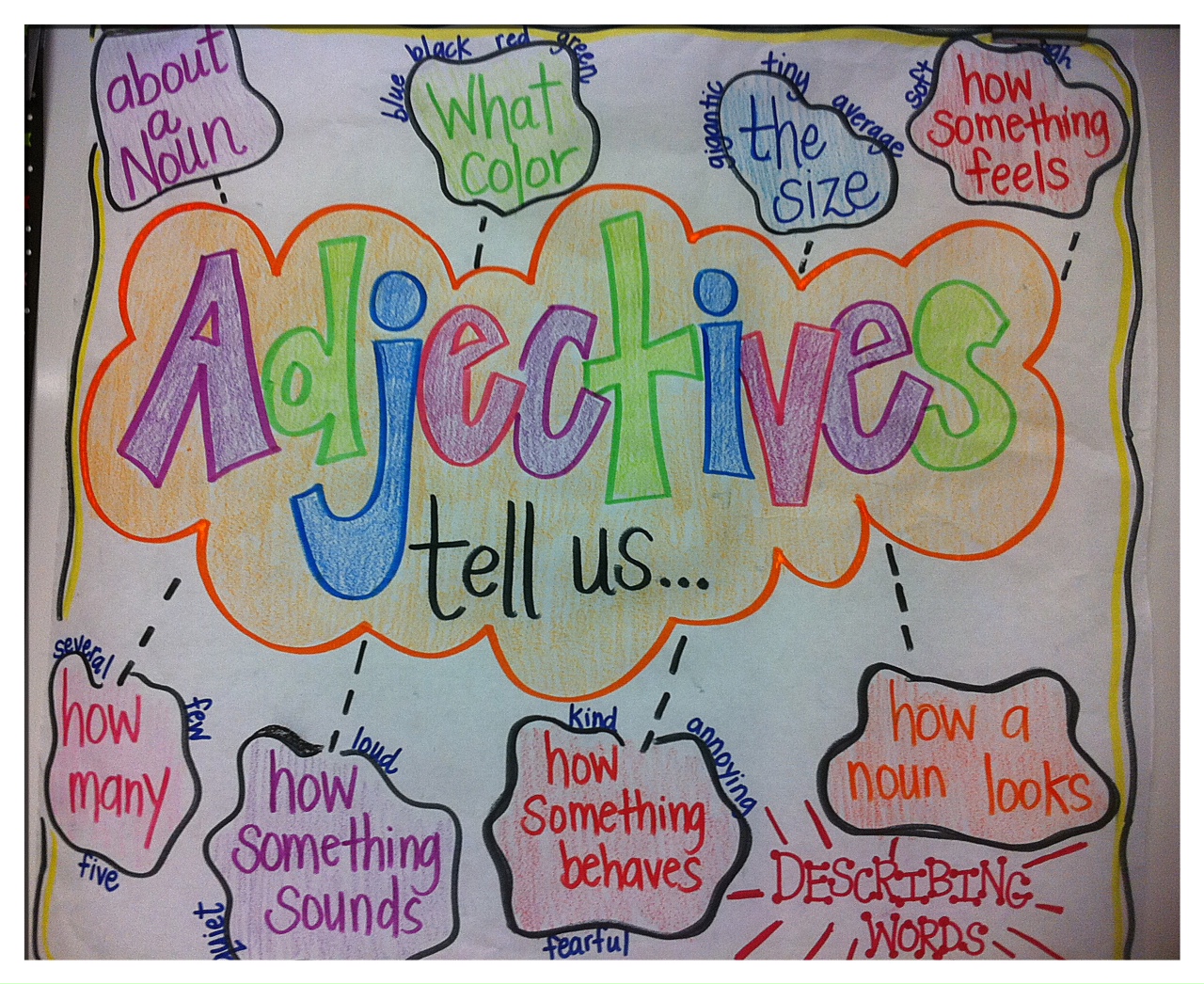
Adjectives Review 1


Adjective Study Guide
Source: http://mrswarnerarlington.weebly.com/
uploads/6/9/0/0/6900648/adjectives3.jpg

  • An adjective is a word that describes a noun or pronoun.  
    • Adjectives tell whose, how much, what kind or how many. 
      • Encyclopedias have accurate information.  (what kind)
      • A library has several dictionaries.  (how many)
  • Articles--a, an, the
    • Articles are special kinds of adjectives.  Use a and an to refer to any one item in a group.  
    • A is used before words beginning with a consonant sound.  
    • An is used before words beginning with a vowel sound.
    • Use the to refer to a particular item or items.
  • Demonstrative Adjectives--this, that, these, those
    • A demonstrative adjective comes before a noun.  
    • Demonstrative adjectives tell which one or which ones.  
    • This and these are used to point out nearby people or things.
    • That and those are used to point out people or things far away.
    • This and that (singular)
    • These and those (plural)
  • A proper adjective is formed from a proper noun.  
    • A proper noun names a certain person, place, thing, or idea.  
    • A proper adjective begins with a capital letter.  (Japanese, African, Hawaiian).
  • Comparative adjectives compare two nouns or pronouns.  
    • Add er to most adjectives or add the word more before longer adjectives.
  • Superlative adjectives compare three or more nouns. 
    • Add est to most adjectives or add the word most before longer adjectives.
  • Forms of good and bad:
    • good, better, best
    • bad, worse, worst
    • _________________________________________________________________-

      4th Grade Language 
      Study Guide – Adjectives/ Review 

      Noun – names a person, place, or thing
      Verb – shows action, or state of being
      Pronoun – takes the place of a noun
      Adjective – describes nouns or pronouns
      1. answers: Which one? What kind? How many? How much? Whose?
      2. a, an, and the are always adjectives – they are called articles

      Writing Comparisons – adding –er or -est
      1. if the adjective ends with a short vowel sound before the final consonant, then double the final consonant before adding –er or –est
      2. if the adjective ends in e, drop the final e before adding –er or -est
      3. whenever you use –er or –est, make sure you state what you are comparing

      Information below is NOT on the next test on 2/27.
      Adverb – describes verbs, adjectives, and adverbs
      1. answers: Where? When? How often? To what extent? How?
      2. often ends in –ly
      Preposition – shows relationship (learn the list of common prepositions)
      Example: The bird flew in her cage.
      Object of the preposition – the noun after the preposition
      Example: The bird flew in her cage.
      Conjunction
      1. joins words or groups of words
      2. common conjunctions include: and, but, or, nor, yet, for
      Interjection – shows strong or sudden feeling
      Example: Ouch! That bee stung me!
      My, look how well you did!

October 17, 2012

4G. Language Review Notes


4th Grade Language 
Review Notes – Letters & Encyclopedia


A friendly letter has five parts
  1. the heading gives the address and zip code of the person writing the letter and the
  2. date that the letter was written
  3. the greeting tells to whom the letter is written, using the word dear and a comma
  4. Example: Dear Grandma,
  5. the body is the letter itself, having each paragraph indented
  6. the closing is a polite or affectionate way to say good bye, it should be capitalized
  7. using a comma
    Example: Love, Sincerely,
  8. the signature is the name of the writer written in cursive
An example of a friendly letter is a thank you note. A thank you note should be long
enough to tell how you feel about a gift or kind thing done for you, why you like it, or
how you can use it. Be specific.

Encyclopedia
  1. a resource book that can be used to gather information on a subject
  2. a set is made up of several books or volumes
  3. letter on the spine guides you to what is contained inside
  4. Example: insects – look in the I volume, George Washington – look in the W volume
  5. sometimes there is too much information under one letter to be stored in one
  6. volume, so two are used
    Example: Ca-Ch and Ci-Cz, look up information alphabetically
  7. guide words are used on each page to help you find information alphabetically
  8. all words are in alphabetical order
  9. in a long article, headings will be used to more easily scan the article
  10. see or see also refers you to other articles that relate to the one you are reading
  11. when researching information on a person, there is a date after their name, the first date is the birth date, the second is the death date, if no death date is given, the person was still alive at the book’s printing
Thank you to Mrs. Penner for this resource from her blog. 

September 25, 2012

4th Grade Language Study Guide (Test 2)

Dear Parents and Students,

Click below to access the 4G. Language Study Guide intended to help students prepare for their Language Test 2 on Wednesday.

Language Study Guide (4G.) Link

Sincerely,

Miss M

April 28, 2012

4th Grade Language Study Guide- Parts of Speech


4th Grade Language Study Guide: Parts of Speech 

NOUN – names a person, place, thing, or idea
  • Examples: Hamilton, teacher, desk, apple, focus, happiness, humility, love, light, school, North Peachtree Academy
  • Example:                                                                                       
VERB – shows action, or state of being 
  • Examples: run, ran, went, is, was, skip, laugh
  • Example:                                                                                       
PRONOUN – takes the place of a noun (replaces a noun)
  • Examples: he, she, it, we, they, their, theirs, ours
  • Example:                                                                                     
ADJECTIVE – describes nouns and pronouns 
  • Examples: pink, the, happy, five, short, few
  •  An adj. answers: Which one? What kind? How many? How much? Whose?
  • Example:                                                                                    
  • Special Adjectives: a, an, and the are always adjectives – they are called articles
  • Example:                                                                                    
    Writing Comparisons – adding –er or -est

  • if the adjective ends with a short vowel sound before the final consonant, then double the final consonant before adding –er or –est
  • Example:                                                                                    
  • if the adjective ends in e, drop the final e before adding –er or -est
  • Whenever you use –er or –est, make sure you state what you are comparing.
  • Example:                                                                                    
ADVERB – describes verbs, adjectives, and adverbs 
  • Examples: happily, gladly, slowly, always
  • An adverb answers: Where? When? How often? To what extent? How?
  • An adverb often ends in –ly
  • Example:                                                                                    
PREPOSITION – shows relationship 
  • Examples: in, toward, above, below, under, at, inside
  • learn the list of common prepositions
  • Example: The bird flew in her cage.
  • Example:                                                                                    
OBJECT OF THE PREPOSITION – the noun after the preposition
  • Example: The bird flew in her cage.
  • Example:                                                                                    
CONJUNCTION: connecting or joining words
  • joins words or groups of words
  • Examples: and, but, or, nor, yet, for
  • Example:                                                                                    
INTERJECTION – shows strong or sudden feeling
  • Examples: ouch, my, wow, oh
  • Example A: Ouch! That bee stung me!
  • Example B: My, look how well you did!
  • Example:                                                                                    

January 23, 2012

Nouns & Pronouns Study Guide

Parents and Students,

Click the link below to see the 4th Grade Study Guide on nouns and pronouns. This is a great tool to use when studying.


-Miss M

Study Guide – Subjects & Predicates

Parents and Students,

Click the link below to see the 4th Grade Study Guide on subjects, predicates, and verbs. This is a great tool to use when studying.

-Miss M

November 30, 2011

Noun Song - Have Fun Teaching

Subject and Predicate Song

Listen to and watch this video to help improve your memory of subjects and predicates.